dingli@dlbio-dryer.com
+86 157-1520-0291(Wechat/WhatsApp)
dingli@dlbio-dryer.com
+86 157-1520-0291(Wechat/WhatsApp)

As a major by-product of the brewing industry, spent beer grains consist primarily of the malt residue remaining after water-soluble carbohydrates have been extracted during fermentation. Rich in nutrients such as proteins and amino acids, they are widely used in animal feed. Statistics show that for every four tons of beer produced, approximately one ton of spent grains is generated; thus, spent beer grains represent a feed raw material requiring large-scale processing.

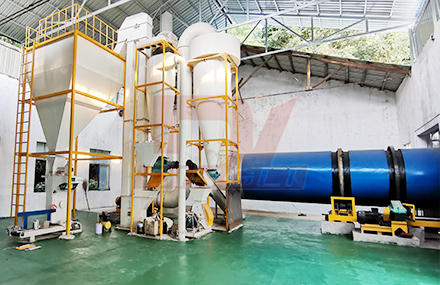
Typically, dewatered spent beer grains have a moisture content of around 70%–75%. Large-scale production requires drying the product to a moisture content below 14%—a safe level for long-term storage. Consequently, processing 2,867 kg of wet raw grains yields 1,000 kg of dried spent grains; in other words, the drying equipment must evaporate 1,867 kg of water. A standard rotary dryer requires 750,000 kcal of heat to evaporate one ton of water. Using biomass pellets as an example—with a calorific value of 4,000 kcal/kg and a price of 1 RMB/kg—the operating cost comes to 374 RMB per ton of dried product.
Have you learned how to calculate the operating cost per ton for drying spent beer grains?


【Location】: Shandong
【Capacity】: 2tph

【Location】: guangdong
【Capacity】: 2tph

【Location】: Russian
【Capacity】: 20tph